Claude Fable 5: Anthropic's Mythos-Class AI Goes Public — What Developers Need to Know
Anthropic just released Claude Fable 5, its first Mythos-class model available to the public. Discover its groundbreaking benchmarks, safety architecture, API details, pricing, and what this means for software engineers and AI practitioners.
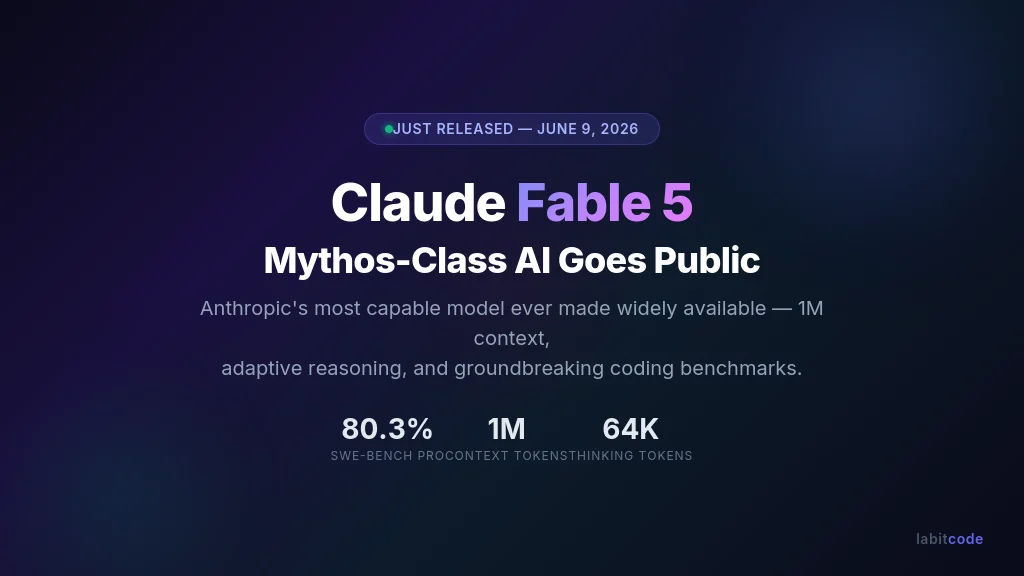
On June 9, 2026, Anthropic crossed a line that many in the AI industry thought wouldn’t be crossed for another year: they released a Mythos-class model to the general public. It’s called Claude Fable 5, and it represents the most capable AI model ever made widely available.
This isn’t just another incremental model update. It’s a carefully engineered compromise between raw capability and public safety — a version of Anthropic’s invitation-only Mythos system, wrapped in a new class of safeguards.
In this deep dive, we’ll unpack everything developers and AI practitioners need to know about Fable 5: benchmarks, architecture, pricing, safety, and what this means for the future of AI-driven software development.
What Is a “Mythos-Class” Model?
To understand Fable 5, you first need to understand the tier system Anthropic has built over the past three years.
| Tier | Models | Description |
|---|---|---|
| Haiku | Haiku 4.5 | Fast, cost-effective, lightweight |
| Sonnet | Sonnet 4.6 | Balanced price-to-performance |
| Opus | Opus 4.7 / 4.8 | Most capable general tier, agentic coding |
| Mythos | Mythos Preview, Mythos 5 | Frontier intelligence, invitation-only |
| Fable | Fable 5 | Mythos capability, general availability |
The Mythos tier emerged in April 2026 when Anthropic revealed that its most advanced internal system — then available only to select research partners — had autonomously discovered thousands of zero-day vulnerabilities, including bugs in OpenBSD code that had gone unnoticed for 27 years.
Fable 5 is the answer to an obvious question: “If Mythos is this powerful, how do you release it safely?”
Technical Specifications at a Glance
Model ID: claude-fable-5
Context Window: 1,000,000 tokens (1M)
Extended Thinking: Up to 64,000 tokens
Adaptive Thinking: Yes (always on)
Input Modalities: Text + Image
Output: Text only
API: Messages API (v1/messages)
Cloud Providers: AWS Bedrock, Vertex AI, Microsoft Foundry
1M Token Context Window
Fable 5 can ingest the equivalent of roughly 750,000 words in a single prompt — enough to hold entire codebases, hundreds of research papers, or multi-year legal document sets. For software engineers, this means you can feed Fable 5 your entire monorepo and ask it to trace a bug across dozens of microservices in one shot.
Adaptive Thinking (Always On)
Unlike Opus models where you manually toggle extended thinking on/off with thinking.budget_tokens, Fable 5 features Adaptive Thinking: the model dynamically decides how much compute to allocate per request. You control it via a simpler thinking parameter:
low— Quick responses, minimal reasoningmedium— Balanced (default for most tasks)high— Deep reasoning for complex coding and researchxhigh— Maximum capability for the hardest problems
Anthropic recommends high as the default for most workloads, reserving xhigh for the most capability-sensitive scenarios.
Benchmarks: Where Fable 5 Dominates
Anthropic published a comprehensive benchmark table comparing Fable 5 against GPT-5.5, and the numbers are striking.
| Benchmark | Claude Fable 5 | GPT-5.5 | Delta |
|---|---|---|---|
| SWE-Bench Pro (agentic coding) | 80.3% | 58.6% | +21.7% |
| GDPval-AA (knowledge work) | 1,932 | 1,769 | +163 pts |
| Computer Use | 85.0% | 78.7% | +6.3% |
| Legal reasoning | Leader | — | — |
| Tool use | Leader | — | — |
| Multidisciplinary reasoning | Leader | — | — |
The SWE-Bench Pro gap is particularly significant: 80.3% means Fable 5 can autonomously resolve complex GitHub issues — writing patches, running tests, and iterating on failures — better than any previously available model. For context, Opus 4.8 scores ~72.5% on SWE-bench Verified, meaning Fable 5 represents roughly a 10-percentage-point leap in a benchmark where each point is hard-won.
What This Means for Developers
# Before Fable 5: Opus 4.8 resolves ~7 out of 10 complex bugs
# With Fable 5: resolves ~8 out of 10

# But the real difference is in the *difficulty tier* —
# Fable 5 tackles bugs that previous models simply couldn't.
The model excels not just at isolated coding tasks, but at multi-agent workflows — the kind of complex, days-long autonomous engineering runs that Anthropic employees use daily in Claude Code. Fable 5 handles the orchestration, delegation, and failure recovery that previously required human intervention.
The Safety Architecture: Fable 5’s Defining Feature
Here’s what makes Fable 5 genuinely novel: it’s the first widely-released model that actively restricts its own capabilities in high-risk domains.
Anthropic built a two-stage safety classifier that monitors every prompt and response:
graph TD
    A[User Prompt] --> B{Safety Classifier}
    B -->|Safe domain| C[Fable 5 responds directly]
    B -->|Cybersecurity flagged| D[Route to Opus 4.8]
    B -->|Biology flagged| D
    D --> E[Response from Opus 4.8]
    C --> F[User receives Fable 5 response]
    E --> G[User receives Opus 4.8 response]
    G -.->|Billing| H[Charged at Opus 4.8 rate]
The Two Restricted Domains
1. Cybersecurity: Prompts related to vulnerability exploitation, malware generation, or offensive security are automatically intercepted. You can still perform legitimate security work — the fallback model (Opus 4.8) handles these requests.
2. Biology: Queries involving biological agent design, synthesis pathways, or dual-use research are rerouted.
The Economic Incentive
Here’s a clever design choice: when a prompt is rerouted to Opus 4.8, you’re charged the Opus 4.8 price, not the Fable 5 price. This eliminates any incentive for Anthropic to over-flag queries — they lose money on every false positive. It’s a rare case where safety design and business incentives align.
Why This Matters
This architecture represents a new paradigm: graduated capability release. Instead of withholding the entire model from public access, Anthropic segments the capability surface and gates only the highest-risk domains. If this approach works at scale, it could become the template for releasing increasingly powerful AI systems.
Pricing and Availability
| Plan | Access | Notes |
|---|---|---|
| Pro ($20/mo) | Included through June 22 | Requires usage credits from June 23 |
| Max ($100/mo) | Included through June 22 | Higher rate limits |
| Team ($25/user/mo) | Included through June 22 | Shared rate limits |
| Enterprise | Included through June 22 | Custom terms |
| API | Pay-per-token | claude-fable-5 model ID |
API Pricing
| Token Type | Price (per 1M tokens) |
|---|---|
| Input | $10.00 |
| Output | $50.00 |
| Cache write | $12.50 |
| Cache read | $1.00 |
At $50/M output tokens, Fable 5 is priced at a premium — roughly 2x Opus 4.8 ($25/M) and ~3.3x Sonnet 4.6 ($15/M). But for tasks where Fable 5’s superior reasoning eliminates multiple retry loops, the effective cost per completed task may actually be lower.
The June 22 Deadline
Fable 5 is included at no extra cost on Pro, Max, Team, and seat-based Enterprise plans from June 9 through June 22, 2026. On June 23, Anthropic will remove Fable 5 from those plans — after that date, using it requires usage credits, though Anthropic plans to restore it as a standard inclusion once inference capacity expands.
For API users, pricing remains at $10/$50 per million tokens regardless of the date.
Fable 5 vs. The Competition
Fable 5 vs. GPT-5.5
Fable 5 leads on every benchmark Anthropic published, but the real-world differences are nuanced:
- Coding: Fable 5’s 80.3% SWE-Bench Pro vs. GPT-5.5’s 58.6% is the widest gap — if you’re building AI coding agents, Fable 5 is the clear choice today.
- Agentic breadth: GPT-5.5 has broader tool integrations and a more mature plugin ecosystem.
- Multimodal: Both handle images, but GPT-5.5 has native audio generation.
Fable 5 vs. Opus 4.8
If you’re currently using Opus 4.8, should you switch?
Switch to Fable 5 when:
- You’re running complex multi-step agent workflows
- You need maximum coding accuracy on hard problems
- Your tasks require days-long autonomous execution
- The task is bottlenecked by reasoning quality, not speed
Stick with Opus 4.8 when:
- You need deterministic extended thinking (manual toggle)
- Your tasks are latency-sensitive
- You’re doing straightforward API calls or RAG pipelines
- Cost is the primary constraint
Fable 5 vs. Sonnet 4.6
Sonnet 4.6 remains the pragmatic choice for most applications. At roughly 1/3 the output cost, it handles 80% of coding tasks adequately. Reserve Fable 5 for the 20% of tasks where superior reasoning actually changes the outcome.
Practical Guide: Using Fable 5 in Your Workflow
1. Setting Up the API
# Install the Anthropic SDK
pip install anthropic

# Set your API key
export ANTHROPIC_API_KEY="sk-ant-..."

# Basic call
python3 -c "
import anthropic
client = anthropic.Anthropic()
response = client.messages.create(
    model='claude-fable-5',
    max_tokens=4096,
    messages=[{'role': 'user', 'content': 'Explain quantum computing in one paragraph.'}]
)
print(response.content[0].text)
"
2. Controlling Thinking Depth
# For complex coding tasks, use 'high' thinking
response = client.messages.create(
    model="claude-fable-5",
    max_tokens=8192,
    thinking={"type": "enabled", "effort": "high"},
    messages=[{"role": "user", "content": "..."}]
)
3. Leveraging the 1M Context Window
# Feed an entire codebase for analysis
import os

files_content = ""
for root, dirs, files in os.walk("./src"):
    for f in files:
        if f.endswith((".py", ".ts", ".js")):
            path = os.path.join(root, f)
            files_content += f"\n--- {path} ---\n"
            files_content += open(path).read()

# This could be 500K+ tokens — Fable 5 handles it
response = client.messages.create(
    model="claude-fable-5",
    max_tokens=4096,
    messages=[{
        "role": "user",
        "content": f"Here is my codebase. Find all security vulnerabilities.\n\n{files_content}"
    }]
)
4. Understanding the Safety Fallback
When Fable 5 routes a query to Opus 4.8, the API response includes a special header:
response = client.messages.create(...)
# Check if the response was routed to the fallback model
if response.model == "claude-opus-4-8":
    print("⚠️ Query was routed to Opus 4.8 for safety reasons")
    print("You were charged Opus 4.8 rates, not Fable 5 rates")
This is transparent and doesn’t produce error responses — the user experience is seamless.
What This Release Tells Us About the AI Industry
1. The Frontier Is Accelerating
Fable 5’s release — just six weeks after Opus 4.8 — signals that Anthropic’s model generation cycle is compressing. The gap between internal frontier models (Mythos) and public releases (Fable) is now weeks, not months.
2. Safety Is Becoming a Product Feature
The safety classifier architecture isn’t just a research paper footnote — it’s a core product differentiator. Anthropic is betting that enterprise customers will pay a premium for a model that’s both more capable and demonstrably safer than alternatives.
3. The Coding Agent Market Is the Battleground
The SWE-Bench numbers make it clear: Anthropic is targeting the developer tools market aggressively. Fable 5’s coding superiority — especially in autonomous, multi-step agent workflows — positions Claude Code as the leading AI coding platform. If you’re building developer tools, the Claude API is now the default choice for the reasoning layer.
4. Graduated Release Is the New Normal
Expect every major AI lab to adopt some version of “powerful model + domain-specific safeguards” as their go-to-market strategy. The era of releasing unrestricted frontier models is likely over.
Key Takeaways for Developers
- Fable 5 is real, it’s available now, and it’s the most capable public model ever released. Start experimenting today — especially if you’re on a Pro, Max, Team, or Enterprise plan where it’s included at no extra cost through June 22.
- The 1M context window + adaptive thinking is a game-changer for codebase-level reasoning. Feed it your entire project and ask architectural questions.
- The safety architecture is transparent and fair. You won’t accidentally pay Fable 5 prices for Opus 4.8 responses.
- June 22 is an important date. On June 23, Fable 5 is removed from subscription plans and requires usage credits. If you want to explore it without burning credits, do it in the next two weeks.
- This isn’t the ceiling. Mythos Preview remains ahead of Fable 5, and Mythos 5 is invitation-only. The models available 12 months from now will make Fable 5 look ordinary.
What’s Next?
Anthropic has hinted that Fable 5’s safety architecture is designed to be portable — meaning future models (Fable 6? Mythos-lite?) could inherit the same classifier infrastructure, accelerating their path to public release.
For developers, the message is clear: the tools are getting dramatically better, dramatically faster. The bottleneck is no longer what AI can do — it’s how quickly we can learn to wield it.
Built with technical precision and artificial intelligence at labitcode. Follow us for more deep dives into the AI tools shaping the future of software engineering.
Join the conversation
Have thoughts on this post? Share them on social media or reach out directly.